


_edited.png)
Wellbeing: Why Are the Cities of the Future Talking About Living Better?

When we talk about the future of cities, the same themes usually come to mind: economic growth, investment, infrastructure, technology, mobility, and new developments.
Yet in recent years, another question has increasingly come to the forefront in cities around the world:
Can a city be planned with the wellbeing of its people at its core?
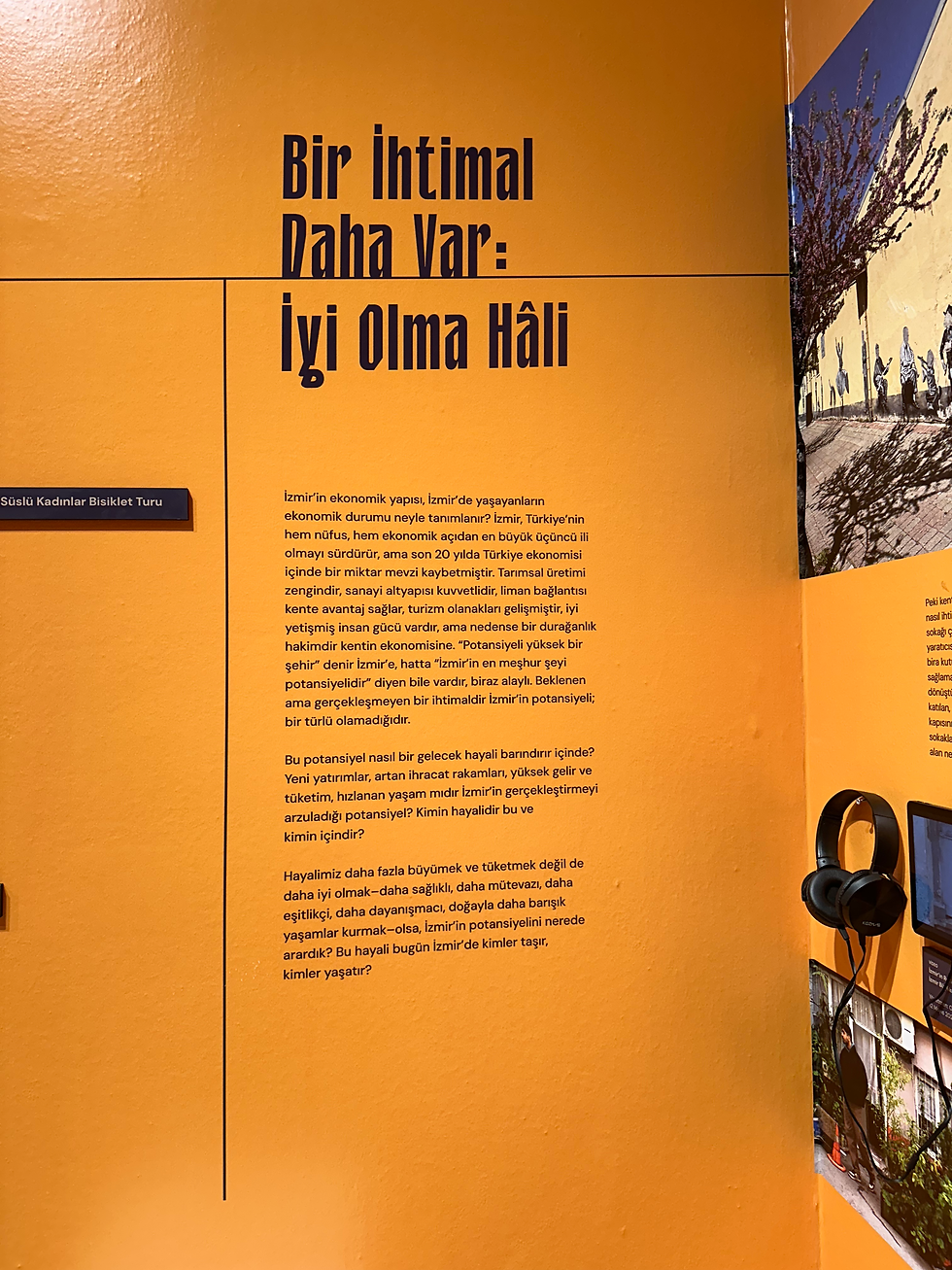
One of the sections that resonated with us most in "Between Two Lines: A Glimpse into İzmir's Future from Today"( İki Çizgi Arasında: Geleceğin İzmir'ine Bugünden Bir Bakış), an exhibition curated by the İzmir Planning Agency (İZPA), was "Another Possibility: Wellbeing," where Originn is also featured.
The reason wasn't simply that Originn is part of the exhibition.
What truly excited us was seeing wellbeing—a concept that has been shaping conversations in cities around the world for years—placed at the centre of a discussion about İzmir's future.
Because this section does more than offer a vision for the future.
It brings into focus an important question that challenges the way we think about and evaluate our cities.
As the exhibition asks:
" What if our ambition wasn't simply to grow and consume more, but to live better—to become healthier, more modest, more equal, more supportive of one another, and more in harmony with nature? Where would we then look for İzmir's greatest potential? "
This is not a question for İzmir alone.
It is one that many cities around the world are beginning to ask.

What Is Wellbeing?
Although the Turkish expression "iyi olma hâli" is often translated as wellbeing, the concept means much more than simply feeling happy.
Today, organisations such as the World Health Organization (WHO), the OECD, and the Oxford Wellbeing Research Centre describe wellbeing as a holistic state that brings together physical health, mental and emotional balance, trust, social relationships, life satisfaction, productivity, a sense of belonging, and purpose.
In other words, the goal is not simply to live longer.
It is to live better.
And perhaps even more importantly...
To live well together.
Why Now?
Ten years ago, conversations about successful cities were largely centred on economic indicators.
We compared their size, growth, and investment capacity.
Today, however, climate change, growing loneliness, chronic stress, burnout, mental health challenges, and widening social inequalities remind us that growth alone is no longer enough.
As a result, urban planning has begun asking different questions.
The challenge is no longer simply to build more housing.
Can we create neighbourhoods where people know one another?
Do people feel safe?
Do children have places to play?
Do public spaces encourage meaningful encounters?
Do people feel a genuine sense of belonging to the city they live in?
Perhaps these are the questions that will define the cities of the future.
What Is the World Telling Us?
This shift is not merely a theoretical discussion.
Today, a growing number of international studies and urban indices point in the same direction.
The OECD Better Life Index measures quality of life not only through income, but also through indicators such as housing, health, education, environmental quality, safety, community, civic engagement, and work–life balance.
Similarly, the World Happiness Report 2025 has chosen "Caring & Sharing" as this year's central theme.
According to the report, the strongest contributors to life satisfaction include:
trust
solidarity
strong social connections
spending time together
helping others
The Happy City Index follows a similar approach, evaluating cities not only by their economic performance but also by the quality of public life, governance, culture, healthcare, mobility, environmental quality, and overall quality of life.
The message shared by these studies is remarkably consistent:
Great cities are not simply wealthier cities. They are places where people trust one another, experience meaningful encounters, and develop a genuine sense of belonging.
Growth or Wellbeing?
This shift is taking place not only in urban planning, but also in the field of economics.
Economist Kate Raworth's Doughnut Economics challenges the idea that the success of a city should be measured solely by economic growth.
Instead, it asks a different question:
How can we meet everyone's essential needs while living within the ecological boundaries of our planet?
Cities such as Amsterdam have already begun applying this framework to their urban policies.
Seen in the context of these global discussions, the question raised by İZPA in the exhibition becomes even more meaningful:
"Is it possible to focus on living better instead of simply growing bigger?"
Urban Wellbeing and Workplace Wellbeing Are Part of the Same Story
We spend a significant part of our lives at work.
For this reason, it is difficult to think about healthy cities without also thinking about healthy workplaces.
Research by Gallup shows that one of the strongest predictors of life satisfaction is the quality of our work experience.
Salary matters.
But so do having meaningful work, opportunities to grow, the ability to contribute to decision-making, and strong social relationships.
All of these have a direct impact on our overall quality of life.
Perhaps this is why we are beginning to ask different questions about work.
Are people simply sharing an office?
Or are they learning from one another?
Is there room for solidarity alongside competition?
Do everyday encounters spark new ideas?
Is it possible to feel part of a community?
Perhaps these questions are just as important as the physical spaces we design.
Can Well-being Be Built Together?
One of the things that made us think most about the IZPA exhibition was that it treated well-being not as an individual goal, but as a way of life that can be built together.
Because well-being isn't just about eating healthy or exercising.
At the same time;
to be able to meet in a neighborhood,
being able to think together,
to be able to produce,
to be able to learn,
to be able to show solidarity,
It's about feeling like you're part of a community.
Perhaps the true potential of cities begins right here.
The Story of Originn and Ahali
We do not see Originn's presence in this section of the exhibition simply as visibility.
We see it as an opportunity to be part of a broader public conversation around a question we have been exploring for a long time.
For nearly ten years, our aim at Originn has not simply been to create a place where people can work.
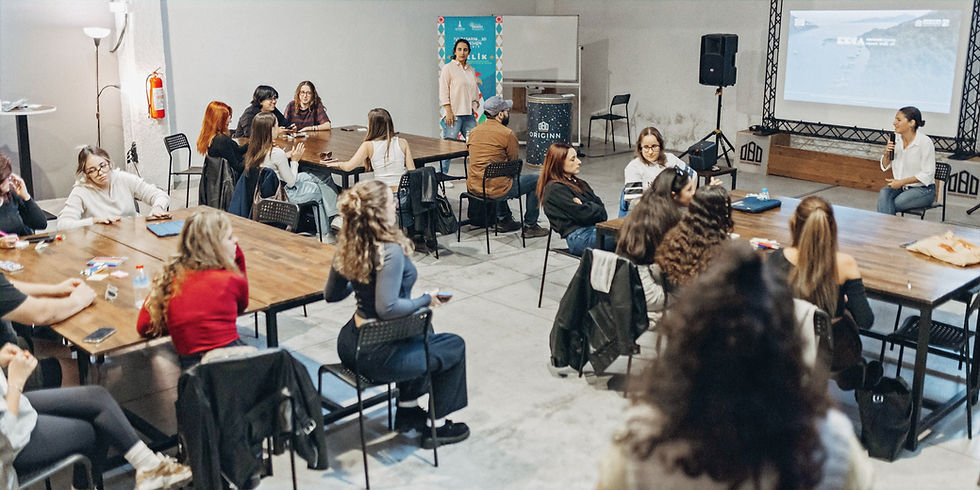
We have been working to create an environment where people can meet, learn from one another, and create together.
Ahali, our community, grew out of this very idea.
It is not a network of people from the same profession, but a community where people from different disciplines can become part of one another's journeys.
Looking back, we realise that many collaborations, friendships, and new ideas did not begin with big projects.
They began with small encounters.
Perhaps that is how wellbeing grows.
Another Possibility
İZPA's title, "Another Possibility: Wellbeing," reminds us of something important.
Cities are not built by buildings alone.
They are built by people.
And good cities become possible when people are not only able to live in them, but also to learn together, create together, support one another, and feel well together.
Perhaps the cities of the future will not simply be bigger. Perhaps they will be better.
Or perhaps what matters most is continuing to ask ourselves what "living well" really means.
Because only the questions we are willing to explore together can become the changes we create together.
References
Izmir Planning Agency (IZPA)Between Two Lines: A Look at the Future of Izmir from Today Exhibitionhttps://www.izmir.bel.tr/tr/Haberler/iki-cizgi-arasinda-sergisi-gelecegin-izmir-ine-kapi-araliyor/58745/156
OECD Better Life Indexhttps://www.oecd.org/en/data/tools/well-being-data-monitor/better-life-index.html
World Happiness Report 2025https://worldhappiness.report
Oxford Wellbeing Research Centerhttps://wellbeing.hmc.ox.ac.uk
Happy City Indexhttps://happy-city-index.com
Gallup – Workplace & Wellbeinghttps://www.gallup.com/workplace
Donut Economics Action Labhttps://doughnuteconomics.org


Comments